CLASSIFIED LEAKS
5 RECORDS ACCESSED MATCHING DOMAIN DIRECTIVE

Terror on American Soil: Iran’s $10 Million Bounty on Barron Trump Signals a Catastrophic Escalation
Washington, D.C. — An unprecedented tipping point in homeland security has been breached. An Iranian state television broadcast explicitly targeting Barron Trump has escalated a menacing threat campaign from generalized political rhetoric to an operationally suggestive hunt for the sitting President’s youngest son. The chilling three-minute video openly offered a $10 million bounty for his assassination while publicly dissecting claimed vulnerabilities in his movements and security arrangements, marking a terrifying new phase in international intimidation A Psychological and Operational Onslaught The broadcast, aired on Iran’s Channel 3 and amplified by media linked to the Islamic Revolutionary Guard Corps (IRGC), was ominously titled, “Where and how should we kill Barron Trump?” It claimed to have “fully monitored” his university campus, escort vehicles, and Secret Service positions , even alleging that the 20-year-old was communicating privately on Xbox, away from his protective detail's immediate oversight. The U.S. Secret Service has formally acknowledged the severity of this psychological warfare. Spokesman Nate Herring confirmed that the agency is actively investigating the video, stating they investigate all perceived threats to protectees, while citing operational security in declining to elaborate on their defensive posture. This terrifying episode is a symptom of a collapsing security perimeter. It closely follows an earlier IRGC-linked video released in July that targeted the former First Lady, titled “Where and how is Melania Trump accessible?” By weaponizing open-source data to map potential access points around a protected family, Tehran is actively erasing the line between geopolitical revenge and state-sponsored domestic terror. The Homeland Under Imminent Threat This hyper-personalized pressure campaign coincides with a much broader deterioration in U.S.-Iran relations, pushing confrontation to the brink of catastrophe. The Department of Homeland Security’s National Terrorism Advisory System (NTAS) continuously warns that the United States is trapped in a "heightened threat environment." DHS intelligence explicitly warns that Iranian leadership's calls for "retributive justice"—stemming from the assassinations of Qassem Soleimani and other key figures—could serve as a violent spark. The ultimate nightmare scenario for federal authorities is that these high-profile bounties will mobilize violent extremists or sleeper cells to execute lone-wolf attacks directly on American soil. The Secret Service is now forced to counter an adversary that is crowdsourcing assassinations through state-funded propaganda. The signal is undeniable: foreign state actors are aggressively probing America's defenses, proving that the theater of war has shifted to our own streets, and not even the most heavily guarded families are entirely safe.

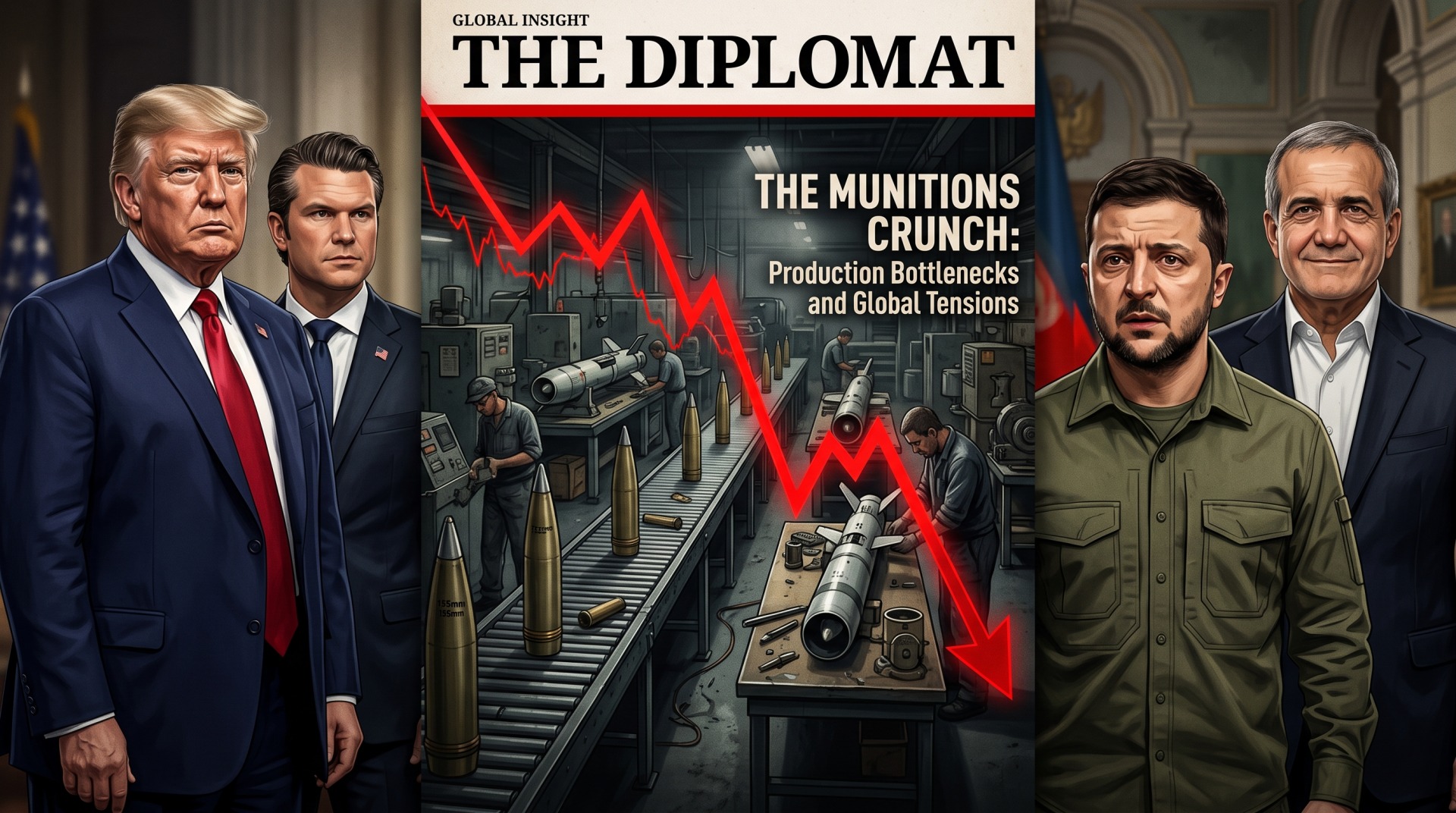
The Production Bottleneck: Measuring the Depth of U.S. Industrial Endurance
Washington, D.C. — For the U.S. military, the most pressing constraint on readiness is shifting from budget battles to the physical limits of the assembly line. While defense spending remains at record levels, the industrial base’s ability to replenish advanced munitions is struggling to match the high rates of consumption seen in active theaters. This gap suggests that military endurance is increasingly dictated by the depth of the production system rather than just the size of the force. Inventory Pressure and the 21-Day Directive Evidence of inventory pressure surfaced following the intensive use of long-range precision-guided systems. According to Reuters , U.S. stocks of the Army Tactical Missile System (ATACMS) and the Precision Strike Missile (PrSM) were nearly exhausted during the Iran conflict. In response, the Pentagon has moved to aggressively press contractors for accelerated production. As reported by the Associated Press , the Department of Defense issued a directive giving defense firms just 21 days to submit concrete plans to increase output. The Washington Post characterized the push as a direct reaction to the rate at which the war with Iran is depleting existing stockpiles. The Complexity of Scaling Production Closing this gap remains a long-term industrial project. On August 17, 2026, the Navy awarded Raytheon a $22.9 billion contract to expand Tomahawk production from roughly 60 units annually to over 1,000. Yet, in an analysis titled "The U.S. Munitions Crisis," the Council on Foreign Relations points out that America's reliance on highly sophisticated weapons creates an inherent vulnerability: these systems cannot be mass-produced with the speed required during sudden spikes in combat intensity. This replenishment challenge extends to air-defense interceptors. Reuters reported . that the U.S. is boosting Patriot and THAAD production to satisfy demand across both the Middle East and Ukraine. At the same time, an August 10 report from the Institute for the Study of War (ISW) noted that Russia has increased its own ballistic missile production. While this primarily impacts the tactical landscape in Ukraine, the expansion of adversary strike capacity potentially increases the long-term demand for a finite Western supply of interceptors. A Test of Industrial Footing There are also indications of tactical crossover between theaters. ISW reports that Iranian forces have reportedly incorporated drone tactics learned from the Russia-Ukraine war, further complicating the defensive requirements for U.S. forces. Ultimately, the central strategic uncertainty is whether the U.S. defense industrial base can reach what the Center for Strategic and International Studies (CSIS) calls an effective "wartime footing." Current production timelines suggest that while technological superiority remains a U.S. hallmark, the endurance of that advantage is being tested by the realities of sustained, multi-theater demand.

White House UAP release opens files, but tightens the frame
WASHINGTON, DC — The new UAP release out of Washington looks less like a bid to settle the oldest claims around UFOs than an effort to get back in front of them. By putting files into public view on a rolling basis, the administration is showing more than it has before while also making clear who gets to define what that material means. The Architecture of Disclosure That approach was explicit in the Pentagon’s May 8 announcement, which said the interagency release was coordinated with the White House and followed President Trump’s direction to declassify records “in the interest of total transparency,” with additional releases to follow. But the structure for that move was built earlier, through the reporting system Congress required from the Office of the Director of National Intelligence and the Defense Department. Their unclassified fiscal 2024 report, published on November 14, 2024, kept the issue inside a familiar frame: airspace awareness, national security and unresolved incidents shaped as much by weak data as by any extraordinary explanation. The National Security Filter AARO has been even clearer about the terms. The office says Congress established it to investigate what hazards or threats unidentified anomalous phenomena might present and to reduce the risk of “technical and intelligence surprise.” In its 2025 declassification paper, AARO also said some UAP information must remain classified for national defense , even as it places “a heavy emphasis on transparency” so the public can see the results of its reviews. That is the balance now taking shape. The government is releasing more raw material, enough to answer the charge that it hides too much, while preserving the authority to classify, interpret and narrow the field of acceptable conclusions. This is disclosure, but it is disclosure managed through agencies, procedures and official review. The Illusion of Full Surrender The limits are already visible. AARO’s 2024 historical review said it found no empirical evidence that the U.S. government or private industry possessed reverse-engineered extraterrestrial technology. At the same time, the broader UAP effort did not end there, because many unresolved cases still appear to turn on limited sensor coverage, incomplete reporting or poor-quality imagery rather than a confirmed exotic origin. So the question is not whether secrecy is ending altogether. It is whether this new phase can reduce public distrust without giving up institutional control over a subject that has resisted tidy explanation for decades. The files are coming out, but the process remains firmly in government hands.

No White House UFO Order, but a Release System Is Taking Shape
Washington still lacks any verified White House order directing a broad release of UAP records. The White House directive issued in January 2025 covered records tied to President John F. Kennedy, Sen. Robert F. Kennedy and the Rev. Martin Luther King Jr. — not unidentified anomalous phenomena. What has taken shape instead is narrower and more procedural. AARO’s public guidance says the office cannot declassify UAP material on its own; release authority remains with the agencies that originated the records, and cleared material may be published through AARO or transferred to the National Archives and Records Administration for public access. That leaves any public release dependent on agency-by-agency decisions, not a single disclosure order from the top. What AARO has said AARO’s March 2024 historical review concluded that it found no empirical evidence that the U.S. government or private companies had reverse-engineered extraterrestrial technology. That finding did not settle the broader fight over access. It clarified the government’s official historical position while leaving a separate question in place: how much underlying material remains classified, compartmented or outside AARO’s own release authority. Taken together, those two points suggest a disclosure process that is real but tightly bounded. Records can move, but only through existing declassification channels and only with the consent of the agencies that control them. The effect is selective transparency, with public access expanding slowly and unevenly rather than through any sweeping release. Pressure from Capitol Hill The House Oversight task force said in April 2026 that its UAP investigation was continuing, cited a lack of transparency and requested additional UAP videos from the Pentagon. That did not establish a hidden White House plan, but it did show that congressional pressure over withheld material has not eased. For now, the stronger signal is not full disclosure. It is a slow, agency-mediated release system in which some material may reach AARO or the National Archives, while control over the most sensitive records appears to remain with the originating institutions.

Trump’s Iran Choices Are Getting Smaller
Trump’s Iran Choices Are Getting Smaller By the time Defense Secretary Pete Hegseth arrived on Capitol Hill on April 30, the argument around Iran had already narrowed. In public remarks on Jan. 29, President Donald Trump said he planned to talk to Tehran, while Hegseth said the military was prepared to carry out whatever the president decided. By the Senate hearing, Hegseth’s own testimony suggested the immediate debate had shifted from whether force was available to how the administration was defining the president’s options. According to congressional testimony on April 30, senators returned repeatedly to the administration’s decision to join Israel in strikes on Feb. 28 without prior congressional authorization, treating that move as a central legal and political rupture. In public remarks on April 6, Trump threatened attacks on Iranian civilian power plants and bridges unless Tehran met U.S. conditions. Reuters reported on April 8 that Trump then agreed to a two-week ceasefire , a move that lowered immediate tensions but left the larger legal and strategic questions unresolved. The Disputed Ceasefire What emerged in the hearing was not a settled account of the war so much as a dispute over how to classify the pause. Hegseth told senators the ceasefire could pause the War Powers timeline, according to congressional testimony on April 30, while senators challenged that interpretation and pressed him on cost, objectives, and legal basis. The Washington Post reported the same day that Hegseth was advancing the ceasefire as a reason Congress did not yet need to approve the conflict, a position that appeared to deepen the fight rather than settle it. That suggests the administration’s public case is being built through a narrow set of signals from the White House and the Pentagon: threats of heavier force, claims of readiness, and shifting descriptions of whether the conflict is active or suspended. According to Pentagon statements on April 24, Hegseth said the U.S. blockade on Iran was “going global,” language that pointed toward expansion even as Reuters had already reported the ceasefire two weeks earlier. Critics said those messages were difficult to reconcile. A Strategic and Legal Vacuum The deeper concern on Capitol Hill is not only escalation. According to congressional testimony on April 30 and The Washington Post’s reporting, Congress still lacks a settled legal and strategic framework while the administration continues to describe the conflict through threats, pauses, and claims of control. That leaves the central dispute unresolved: not whether the president has military options, but whether the public case for using them is being defined on stable legal and strategic ground.