The Fire Below Deck: How a Laundry Room Blaze Exposed the Fragility of America’s Most Advanced Aircraft Carrier
RED SEA — Aboard an American nuclear-powered aircraft carrier, the machinery that projects mi...
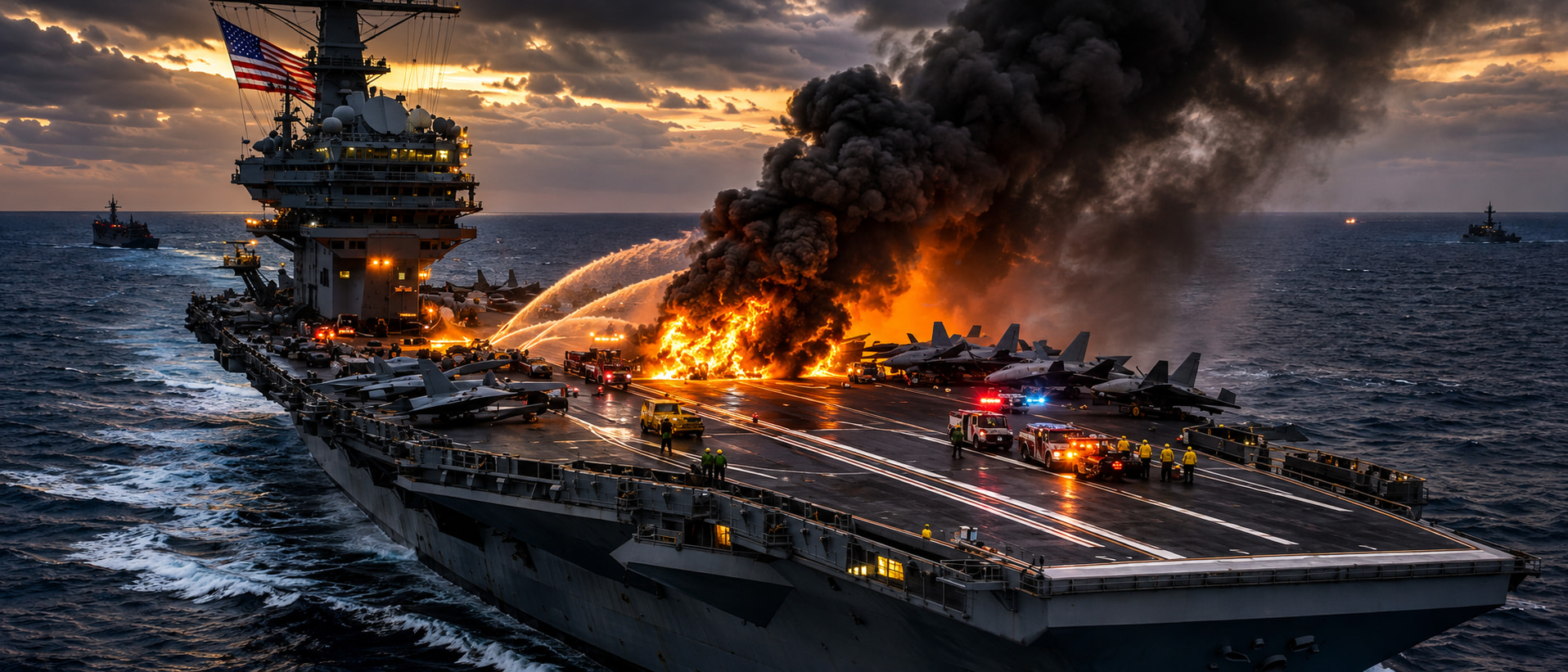
RED SEA — Aboard an American nuclear-powered aircraft carrier, the machinery that projects military power across thousands of miles can appear almost indestructible.
Then a fire starts in the laundry.
On March 12, 2026, the USS Gerald R. Ford, the U.S. Navy’s newest and largest aircraft carrier, suffered a fire in its main laundry spaces while operating in the Red Sea. The Navy said the fire was not combat-related, that its propulsion plant was not damaged and that the ship remained operational. Two sailors were initially reported to have suffered non-life-threatening injuries.
The incident did not cripple the carrier.
But it exposed something more consequential than the immediate damage: even the most sophisticated warship in the American fleet remains dependent on thousands of mundane systems whose failure can rapidly become an operational problem.
And on a carrier deployed for months in a combat environment, a fire in a laundry space is not simply a fire in a laundry space.
It is a test of containment, damage control, crew resilience, habitability and the Navy's ability to keep a 100,000-ton warship functioning when one part of its internal ecosystem suddenly becomes unusable.
The Fire Was Not an Attack
The first fact matters most.There is no evidence that the fire was caused by enemy action.
U.S. Naval Forces Central Command explicitly described the incident as non-combat-related. The Navy also said there was no damage to the carrier's propulsion plant and that the ship remained fully operational immediately after the incident.
That distinction is critical because the Ford was operating in an active regional conflict environment.
The carrier had been participating in U.S. operations against Iran and was operating in the Red Sea when the fire occurred. Reuters later reported that the ship would temporarily leave the operational area for repairs after the incident.
What began as an internal casualty therefore became a strategic logistics problem.
The carrier had to preserve its combat capability while simultaneously dealing with damage inside the ship, assessing affected spaces and determining whether repairs could be conducted without returning to a major naval facility.
That is the hidden vulnerability of modern naval warfare.
The most dangerous failure is not necessarily the one caused by an enemy missile. It can be the failure that forces a warship to stop doing what it was built to do.
A Fire Can Become a Habitability Crisis
Subsequent reporting showed that the consequences were considerably larger than the Navy's initial two-injury statement suggested.Reuters reported that the fire affected roughly 100 sleeping berths, while nearly 200 sailors were treated for smoke-related issues. The affected spaces required significant rehabilitation before the carrier could fully recover its normal living arrangements.
That matters because an aircraft carrier is not simply a weapons platform.
It is a floating city.
Thousands of sailors and Marines live, work, eat, sleep and maintain aircraft inside a highly compartmentalized steel structure. Every basic function — food, sanitation, electricity, ventilation, water, berthing and laundry — is part of the ship's ability to sustain combat operations.
When one of those systems fails, the consequences can propagate.
A destroyed berthing compartment means sailors need alternative sleeping arrangements. Damaged ventilation or electrical systems can affect adjacent spaces. Smoke can force medical evaluations. Repairs can require isolation of compartments. And every additional maintenance task consumes personnel who may already be operating under extreme tempo.
That is why the real measure of a shipboard fire is not simply how much steel burned.
It is how many interconnected systems the fire forces the crew to reorganize.
The Navy's Most Advanced Carrier Meets an Old Problem
The Gerald R. Ford class represents one of the largest technological investments ever made by the U.S. Navy.Its value is not limited to the hull itself. The carrier integrates nuclear propulsion, electromagnetic aircraft launch systems, advanced arresting equipment, radar, aviation maintenance, weapons handling, communications and thousands of individual support systems.
Yet none of that eliminates the basic physics of fire.
A ship remains a confined environment surrounded by fuel, electrical equipment, machinery, personnel and oxygen.
The Navy's entire damage-control philosophy exists because of that reality.
A carrier must be capable of fighting fires while simultaneously keeping propulsion, aviation operations, communications and life-support systems functioning. The ability to isolate damage is therefore as important to survivability as the weapons mounted on the ship.
The Ford incident did not demonstrate that the carrier failed this test.
Quite the opposite: the Navy said the propulsion plant was unaffected and the ship remained operational.
But the incident demonstrated why damage control remains a central combat capability even aboard America's most technologically advanced warships.
The Bigger Problem Was the Deployment
The timing of the fire made the incident more consequential.The Ford had already been operating on an unusually long deployment. Reuters reported that the carrier had been deployed for approximately nine months when the fire occurred, including operations in the Caribbean before moving into the Middle East.
Extended deployments place additional demands on maintenance systems.
Ships are designed to operate for long periods at sea, but maintenance does not disappear simply because the vessel cannot easily return to port. Instead, crews must continuously balance operational requirements against equipment degradation, repairs and the basic needs of the people living aboard.
The laundry fire therefore became part of a larger question:
How much additional operational pressure can a complex warship absorb before individual failures begin interacting with one another?
That question is larger than the Ford.
It applies to any military force operating at a sustained tempo where maintenance windows, replacement crews and port access become increasingly difficult to schedule.
Seven Berthing Compartments Had to Be Rehabilitated
The subsequent repair process illustrates how quickly a relatively localized fire can become an engineering problem.USNI News reported that after the Ford reached Souda Bay, Greece, Navy structural engineers, naval architects and other specialists conducted a repair assessment. Military and federal civilian law-enforcement personnel also continued investigations into the fire.
Seven berthing compartments affected by the fire were rehabilitated by ship's-force personnel and local industry partners.
That detail is important because it puts the event into physical perspective.
The Navy did not describe the carrier as disabled.
Instead, the response involved assessment, investigation, structural repair and restoration of living spaces while preserving the ship's broader operational capability.
That is precisely how modern military resilience is supposed to work.
But resilience has a cost.
Every repair requires labor. Every damaged space requires inspection. Every compartment removed from normal use creates additional logistical pressure elsewhere.
A ship can remain technically operational while simultaneously becoming more difficult to operate.
The Lincoln Comparison Is a Different Story
There is another reason this incident has become easy to misreport.The USS Abraham Lincoln, another U.S. aircraft carrier, has separately faced intense scrutiny in August over the length of its deployment and reports concerning living conditions aboard the ship.
Reuters reported that the Lincoln's deployment had exceeded 260 days, with concerns raised by families and lawmakers about mental health, living conditions and the lack of port calls. Defense Secretary Pete Hegseth rejected descriptions of the ship's conditions as inaccurate.
The AP likewise reported that the Lincoln had spent more than 240 consecutive days at sea and that reports had emerged concerning food, supplies, mental health and other conditions aboard the ship.
The Lincoln has also reportedly experienced a laundry outage, but that should not be confused with the March fire aboard the Gerald R. Ford.
The distinction is more than editorial housekeeping.
It matters because combining the two incidents would create a false narrative that the Lincoln itself suffered the March laundry fire.
It did not.
The Fragility Beneath the Armor
That distinction actually makes the broader story more interesting.The Ford fire and the Lincoln's later deployment problems involve different ships and different circumstances. But together they illustrate a common problem facing modern navies:
combat power depends on systems that are rarely visible to the outside world.
A carrier's ability to launch aircraft is obvious.
Its ability to keep thousands of people fed, rested, medically supported, supplied and housed is not.
Yet those functions determine how long the ship can remain effective.
The U.S. Navy can build a carrier capable of projecting air power across an ocean. It cannot eliminate the physical constraints of fire, fatigue, maintenance, sanitation or human endurance.
Those constraints do not disappear when a warship enters a combat zone.
They become more important.
The Real Warning Is Not the Fire
The March 12 fire did not destroy the Gerald R. Ford.It did not disable its nuclear propulsion system.
It was not an Iranian attack.
And the available evidence does not support portraying it as a near-catastrophic loss of the carrier.
The more revealing lesson is quieter.
A modern aircraft carrier is an extraordinarily resilient machine precisely because thousands of people and thousands of systems are constantly preventing small failures from becoming large ones.
When something breaks, the Navy does not simply repair a component.
It must preserve an entire ecosystem.
That is the vulnerability hidden beneath the armor.
America's carriers are designed to survive attacks that can be seen coming. Their harder problem may be sustaining the invisible infrastructure — maintenance, habitability, crew endurance and damage control — that keeps those weapons platforms alive long enough to fight.
The fire began in a laundry room.
Its strategic significance lies in what came afterward.