EU Issues 72-Hour Emergency Guidance as Japan Launches Disaster Agency
On November 3, 2026, the EU issued nonbinding guidelines for 72-hour emergency readiness. Japan launched a disaster agency November 2, 2026, and urged at least three days of household supplies. Neither action establishes an imminent threat.
Sources & references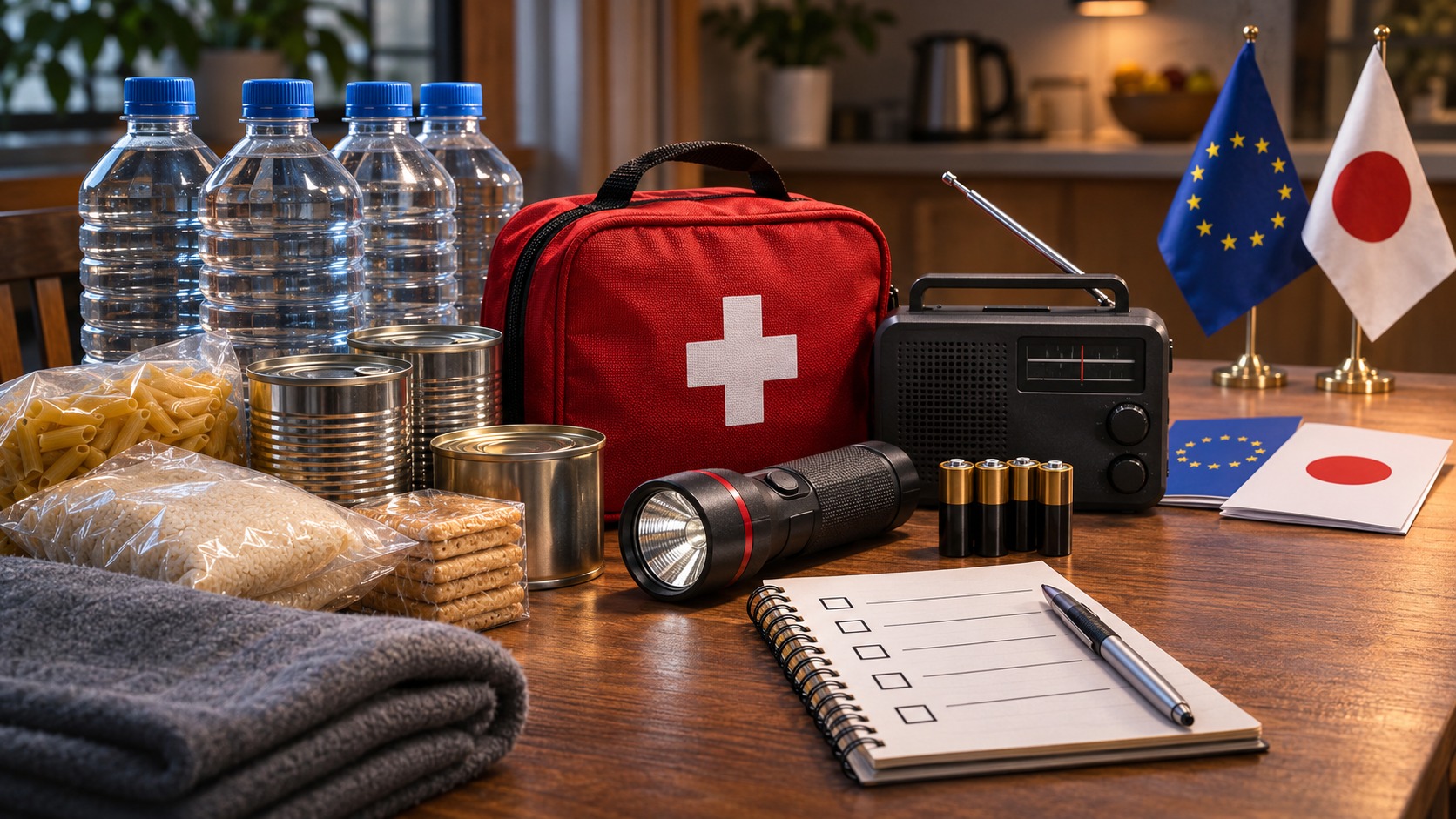
The European Commission presented nonbinding guidance for the first 72 hours of an emergency on November 3, one day after Japan launched a national disaster agency and urged residents to stock food and water. The actions were separate, but both put household supplies alongside the limits of immediate public response.
The First Three Days
The European guidance asks authorities to help people meet essential needs while public assistance is being mobilized. Its 72-hour self-sufficiency principle covers emergency supplies and grab bags, not a promise that government services or outside help will be fully restored after three days. That distinction matters when a prolonged disruption affects access to water, food, sanitation or communications.
The Commission's November 3 guidelines also address preparedness education, disability inclusion and risk communication. They encourage lessons for young children, accessible planning for people with disabilities and clearer public information before, during and after emergencies. The measures are nonbinding, leaving their practical adoption to the relevant authorities.
Japan's approach uses a similar minimum supply period but recommends a longer reserve where possible. In its November 2 emergency request, the new National Disaster Management Agency urged households to keep at least three days of food and water, preferably one week. It also called for portable toilets, secured furniture, emergency bags and checks of evacuation sites and routes.
The agency's message directly addresses response capacity. Japan's government said official resources could be stretched during disasters of national scale and warned that assistance might not arrive immediately. Its appeal is a preparedness request, not an estimate of how long any future disruption would last. The parallel with Europe's three-day buffer while public assistance is mobilized suggests a shared concern about the period before emergency assistance can reach everyone, without establishing that the two announcements were coordinated.
An Existing Policy, Not a Fresh Warning
The EU's 72-hour concept is not new. Its Preparedness Union Strategy, published March 26, 2025 already encouraged households to maintain essential supplies for at least three days. The November announcement provides more detailed guidance on how communities and public authorities can prepare; it does not mark the first time Brussels adopted that benchmark.
There is a separate distinction between household advice and national reserves. The Commission launched an EU Stockpiling Strategy in July 2025 covering essential goods and plans to identify stock gaps, coordinate reserves and improve distribution. That existing strategy is not evidence of a new extraordinary buying surge tied to this week's household guidance. The cited announcements do not quantify a new wave of emergency purchases.
Japan's institutional change is more immediate. The Associated Press reported that the new agency has more than 350 staff assigned to preparedness, emergency response and reconstruction. Its establishment and the accompanying public request address the country's long-standing natural-disaster risks, rather than a newly announced prediction of a particular event.
The distinction was made explicit by disaster management minister Goshi Hosono. At a November 2 news conference, Hosono said authorities had received no special information on earthquake prediction, according to Jiji Press, whose account was published by Nippon.com. That documents the minister's stated position, not independent access to everything known inside government.
Both governments have announced preparedness measures, but the available records do not establish a coordinated warning, an imminent war, a predicted disaster or an ongoing infrastructure collapse.
The Operational Tests Still Ahead
The new measures also reach beyond household storage. The Commission has described recommendations for continuity planning and stress-testing of national civil protection contact points, aimed at keeping those systems operating during disruptive events. Japan has asked local governments and ministries to review training, shelters, supply arrangements and continuity plans, including preparedness measures involving businesses.
In Japan, progress reports are requested by year-end from prefectures and national ministries. In Europe, the November guidelines remain voluntary. Neither set of documents establishes how many households already have adequate supplies, how consistently member states will apply the EU recommendations, or whether the new measures will reduce delays in an actual emergency.
Nor do the reviewed records establish any formal EU-Japan coordination that produced the two announcements. Their timing may reflect a broader emphasis on getting through the first hours of a crisis, but a preparedness target is not a measured response capability. Japan's year-end reviews and any future EU continuity tests offer a concrete way to assess whether the systems meant to deliver assistance can function when households need them most.
What we know
- The European Commission presented nonbinding population preparedness guidance on November 3, 2026, covering 72-hour self-sufficiency. [1]
- Japan launched its National Disaster Management Agency on November 2, 2026. [3]
- Japan's November 2 emergency request recommends a minimum three-day, preferably one-week, food and water reserve. [2]
- The EU Preparedness Union Strategy of March 26, 2025, already encouraged at least 72 hours of essential household supplies. [4]
- The European Commission announced an EU Stockpiling Strategy on July 9, 2025. [5]
- The Associated Press reported that more than 350 employees were assigned to Japan's new agency. [3]
- Japan's emergency request asks prefectures and ministries to report preparedness progress by year-end. [2]
- Jiji Press reported that minister Goshi Hosono said the government had received no special information on earthquake prediction. [6]
- The Commission described nonbinding recommendations on continuity planning and stress-testing for civil protection contact points. [1]
What remains unclear
- How extensively EU member states will apply the new nonbinding guidance remains unknown.
- Actual household compliance with the advised emergency supply periods in the EU and Japan has not been established.
- Whether the new measures will measurably reduce response delays or essential-service interruptions is not established.
- No formal EU-Japan coordination specifically behind the two announcements was established in the reviewed records.
Sources & references
- Commission takes new steps to prepare Europeans for growing crisis risks
Official Statement · European Commission, Directorate-General for European Civil Protection and Humanitarian Aid Operations · 2026-11-03
Context & limitations
Commission account of its own nonbinding population guidance and separate continuity recommendations; describes policy, not implementation or measured outcomes.
- 事前防災徹底のための緊急要請
Official Statement · Japan National Disaster Management Agency (防災庁) · 2026-11-02
Context & limitations
Japanese-language official emergency request and institutional review instructions. Describes requested preparedness and possible response constraints, not a disaster forecast or measured readiness.
- Japan launches a new national agency to deal with disasters
Independent Reporting · The Associated Press · 2026-11-02
Context & limitations
Original reporting by Mari Yamaguchi; November 2 publication date confirmed in AP's indexed dated record, though not visible in the extracted on-page article view.
- EU Preparedness Union Strategy to prevent and react to emerging threats and crises
Official Statement · European Commission, Directorate-General for European Civil Protection and Humanitarian Aid Operations · 2025-03-26
Context & limitations
Primary Commission announcement of 2025 preparedness policy; establishes preexisting 72-hour principle, not household uptake or later implementation.
- EU Stockpiling and Medical Countermeasures Strategies to strengthen crisis readiness and health security
Official Statement · European Commission, Directorate-General for European Civil Protection and Humanitarian Aid Operations · 2025-07-09
Context & limitations
Describes a strategic program and intended coordination, stock-gap identification, reserves and logistics; does not establish extraordinary procurement in November 2026.
- Japan's New Disaster Agency Faces Test as Control Tower
Independent Reporting · Nippon.com · 2026-11-03
Context & limitations
Jiji Press reporting carried by Nippon.com. Confirms Hosono's reported press-conference statement, not independent knowledge of undisclosed government intelligence.