Election Cybersecurity Scramble Exposes a Federal-State Coordination Test
Before Nov. 3, specialists report weaker federal-state election threat-sharing. Arizona made emergency software changes, and a Florida vendor restored voter-lookup tools. CISA says support remains available; nationwide effects are unproven.
Sources & references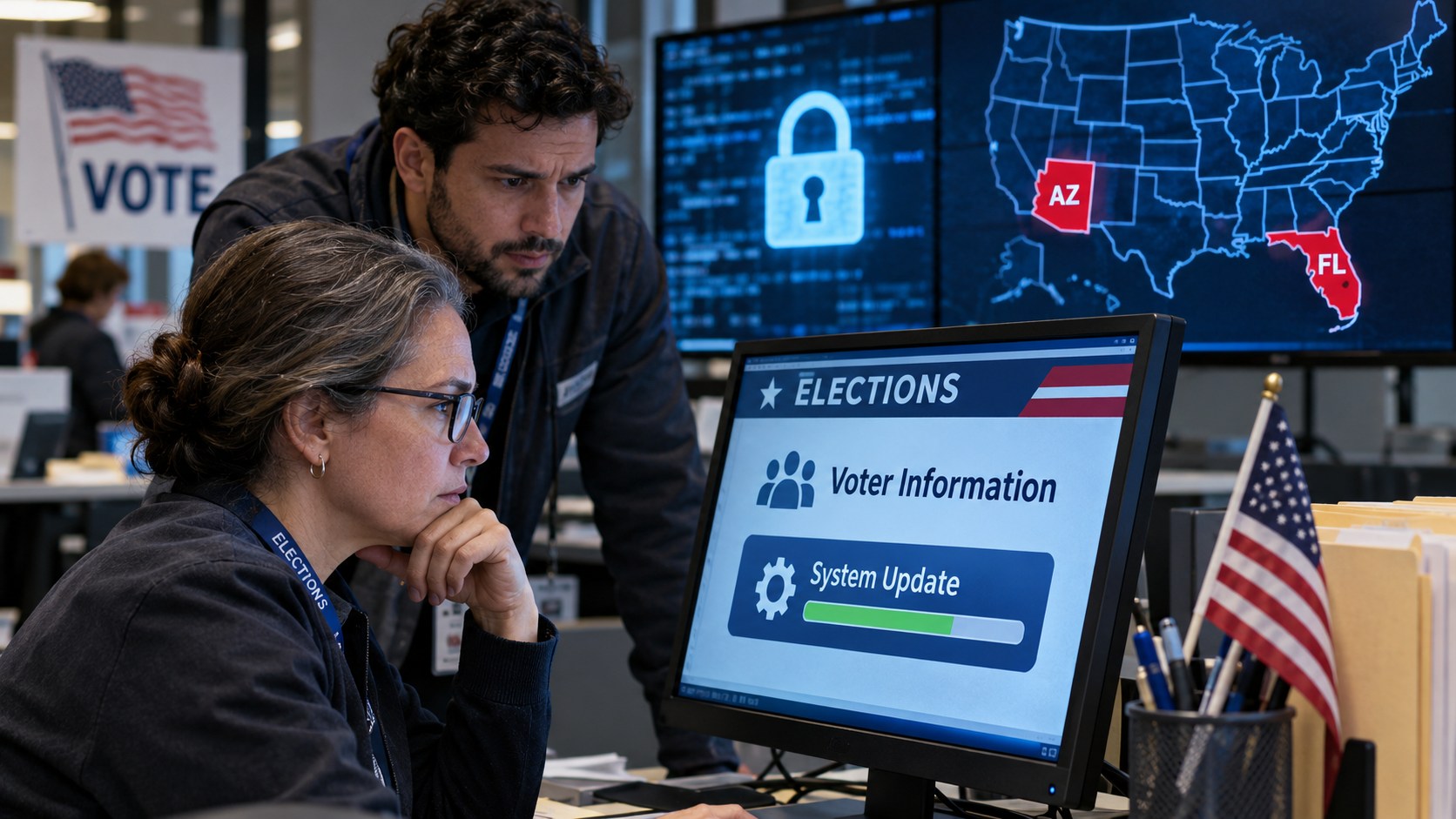
With the November 3 midterms approaching, election officials are responding to software threats while some security specialists report weaker federal-state communication. Arizona made emergency system changes, and a Florida vendor briefly suspended online voter tools. The immediate test is whether election offices can spot and contain disruptions quickly, not whether the reported incidents altered ballots.
Reporting by CNN on November 1 described election-security specialists' concerns about deteriorated channels for sharing foreign cyber and influence-threat information. Among those cited were Ryan Macias and David Becker, who described reduced communication and trust. Their observations are serious, but they do not amount to a nationwide audit of the assistance available to election administrators.
The concern predates the final stretch of campaigning. In September, the Associated Press reported complaints from state officials about uneven access to federal penetration testing, exercises and intelligence briefings. The same reporting found that West Virginia was still receiving some support. That difference matters: reduced engagement in some places does not establish that federal election-security services have stopped everywhere.
The Software Deadline Hit Election Operations
The pressure became tangible when PHP maintainers issued critical security fixes on October 21. The fixes addressed two vulnerabilities that could permit unauthenticated remote code execution under affected conditions. A published vulnerability is not evidence that attackers breached an election system. But an urgent update can still force officials and vendors to change software during a period ordinarily devoted to stability.
In Arizona, chief information security officer Michael Moore described rapid security changes ahead of the election in response to the newly identified risk, according to The Washington Post. The operational problem was timing: responders had to address exposure without the luxury of a long maintenance window.
Florida offered a more visible example. Election technology vendor VR Systems temporarily took public voter-lookup tools offline on October 21, Suncoast Searchlight reported. The tools were reportedly unavailable from roughly 10 a.m. to 7 p.m. before service was restored that evening. The vendor said the interruption did not affect voter rolls or the ability to cast ballots.
That distinction is central. Public-facing tools help voters retrieve information, but their availability and the integrity of vote-casting and tabulation systems are not the same question. A precautionary shutdown can interrupt access to election information without showing that votes have been changed.
The Federal Assistance Dispute
Federal officials reject the idea that assistance has vanished. CISA told The Washington Post that election offices could still request technical advice and vulnerability scans, along with regional help. The agency also reported briefing partners about the PHP vulnerability.
A CISA spokesperson separately told CNN that it had launched a new information-sharing tool for authorized government partners. How widely election officials are using it remains unknown: CISA did not provide CNN an access count. Availability and operational uptake are different measurements, and neither the complaints nor the agency's response establishes a nationwide failure.
The federal government's October warnings also show continued formal threat communication. In an October 16 advisory, the FBI and CISA warned of phishing, impersonation and messaging-based attacks against election and campaign officials. The advisory identifies methods to watch for, not a confirmed election intrusion.
What November 3 Can—and Cannot—Show
The Election Assistance Commission describes layered voting-system safeguards, including testing, custody controls and audits. Those procedures are relevant counterweights to fears that a software emergency involving a voter-information website signals compromised ballot counting. They do not, however, measure the current response capacity of every local election office.
Some state officials also describe continuity rather than retreat. New Mexico's secretary of state's office told CNN its approach to preventing foreign interference had not changed. Preparedness differs across jurisdictions, and the available reporting cannot produce one national measure of readiness.
The unresolved risk is coordination. If threat intelligence reaches local administrators unevenly while emergency fixes are underway, an incident affecting public election services could be harder to identify, communicate or contain. That is a qualified operational inference, not evidence of a coordinated attack or a prediction that one will occur.
Ahead of Tuesday's vote and the subsequent reporting period, key measures remain unverified: how many offices are using the new federal sharing tool, how consistently alerts reach local officials, how many public web systems remain unpatched and whether any communication gap actually slows a response. The observable test is the response to a real incident, should one emerge—not the existence of contingency plans.
What we know
- PHP published October 21 security releases addressing two critical remote-code-execution vulnerabilities. [3]
- Arizona cybersecurity official Michael Moore described emergency election-system security changes ahead of November 3. [4]
- VR Systems disabled Florida public voter-lookup tools on October 21, and the tools were restored that evening. [5]
- CISA told CNN it had launched an information-sharing tool available to authorized government partners upon request. [1]
- CISA told The Washington Post technical advice and vulnerability scans remained available upon request. [4]
- The FBI and CISA issued a public election-cybersecurity advisory on October 16. [6]
- The Election Assistance Commission describes voting-system testing, custody protections and audits. [7]
- New Mexico's secretary of state's office told CNN it had not shifted its approach to preventing foreign interference. [1]
What remains unclear
- How many election offices have accessed CISA's new information-sharing tool.
- How consistently federal cyber-threat intelligence is reaching individual election jurisdictions.
- How many election-related public web systems remain unpatched against the October PHP vulnerabilities.
- Whether reported coordination gaps will measurably delay incident response on November 3.
Sources & references
- Election officials brace for foreign threats — and an unpredictable Washington
Independent Reporting · CNN via KESQ · 2026-11-01
Context & limitations
Interviews and attributed CISA response; not a nationwide readiness audit. No CISA tool usage count disclosed to CNN.
- 40 days to midterms, election officials say new US cyber plan comes too late
Independent Reporting · The Associated Press · 2026-09-24
Context & limitations
Reports officials' accounts of uneven support; some West Virginia assistance continued. Publication date cross-checked against dated AP syndication.
- Security advisory: Critical remote code execution vulnerabilities, update now
Primary Record · PHP Project · 2026-10-21
Context & limitations
Advisory entry within PHP's 2026 news archive; establishes vulnerabilities and fixes, not exploitation of an election system.
- New hacking threat has election officials scrambling weeks before the midterms
Independent Reporting · The Washington Post · 2026-10-31
Context & limitations
Arizona official account and attributed CISA availability statement; does not establish uniform support or cyber intrusion into vote counting.
- Voter lookup tools go down across Florida as early voting begins
Independent Reporting · Suncoast Searchlight · 2026-10-21
Context & limitations
Updated October 22. Reports service outage and restoration; vendor says rolls and voting unaffected.
- Cyber Threat Actors Use a Variety of Techniques to Target Election and Campaign Officials
Official Statement · FBI and CISA, Internet Crime Complaint Center · 2026-10-16
Context & limitations
Threat-awareness advisory describing tactics; not confirmation of a current successful intrusion.
- Are voting systems secure?
Official Statement · U.S. Election Assistance Commission · 2026-08-31
Context & limitations
Describes safeguards, testing, custody controls and audits; does not certify real-time preparedness of every jurisdiction.