Abu Dhabi Talks Resume as Lavrov and Von der Leyen Differ on Security Sequence
U.S.-mediated talks in Abu Dhabi ended their first day November 10; talks were due to resume November 11. Lavrov and von der Leyen differ on security sequencing. European officials joined separate consultations, not the trilateral session.
Sources & references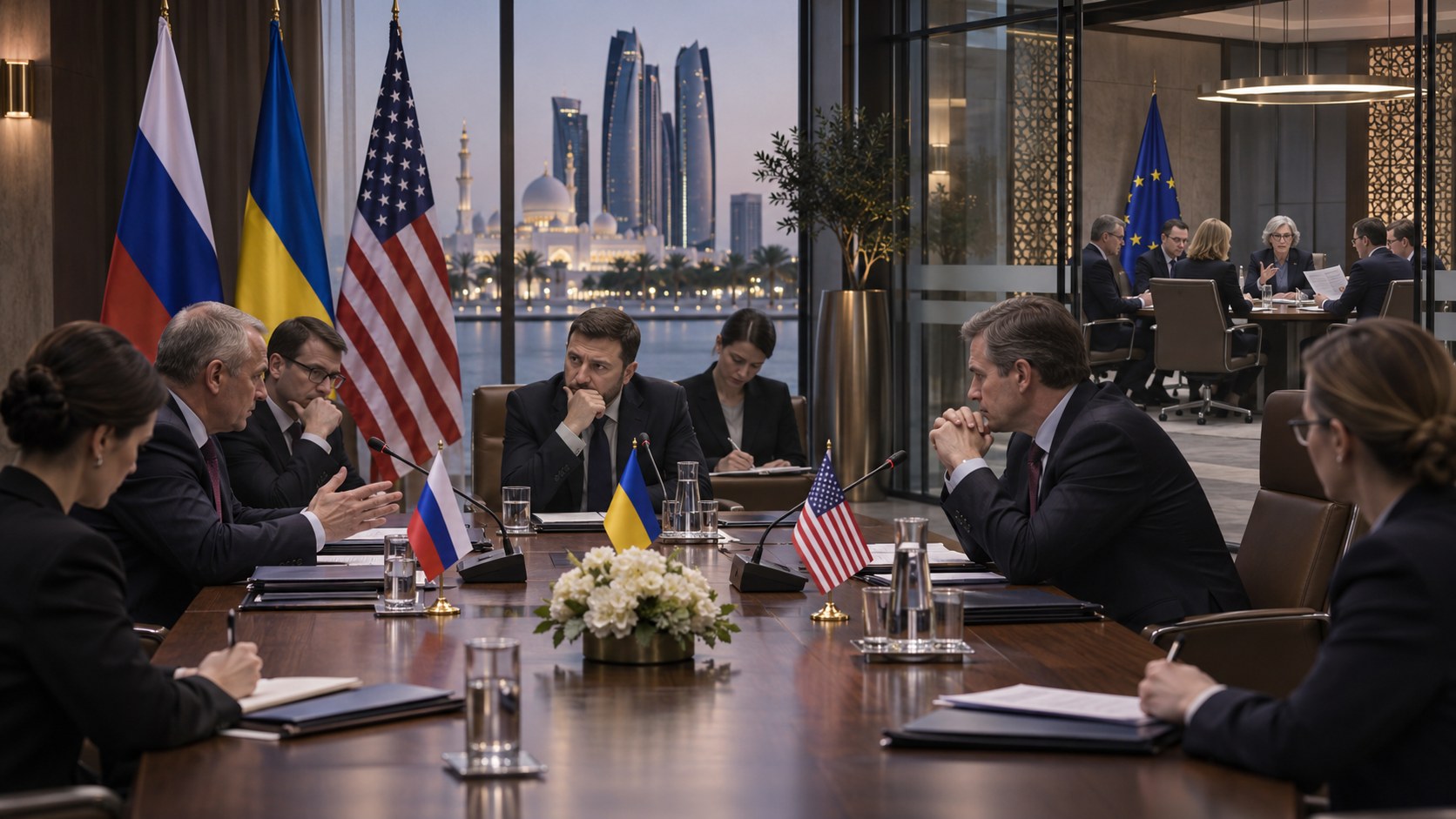
U.S.-mediated Russia-Ukraine talks convened in Abu Dhabi on November 10 and ended their first day after more than four hours. European representatives met separately with Ukrainian and American officials before the trilateral session. The meetings took place, but no settlement was announced. The delegations were expected to resume talks November 11.
The first day's contact establishes that the negotiating channel is active, not that the sides have narrowed their differences over security commitments. Reuters reported no immediate Russian account of the substantive discussions, a limit on what can be said about the meeting rather than evidence of a rejection.
A Dispute About What Comes First
Russian Foreign Minister Sergei Lavrov argued that a wider European security architecture should be defined before resolution of the war. European Commission President Ursula von der Leyen said broader European security negotiations should follow a ceasefire in Ukraine.
That difference concerns the order of commitments, not simply their content. If the negotiating sequence itself is disputed, a proposal that one side treats as a prerequisite may be one the other wants postponed. The opposing public positions do not demonstrate that the Abu Dhabi meetings failed, and neither position establishes that the other governments accepted it.
For Ukraine, the distinction bears on what long-term protections could accompany a settlement. For European governments, it bears on when their broader security arrangements would come under negotiation. These are possible consequences of the competing approaches, not outcomes reached at the table.
Consultation Does Not Mean a Seat at the Table
The European Council's November 10 coordination statement documented talks involving the EU, France, Germany, Italy, the United Kingdom, Ukraine, the United States and NATO. Participants emphasized Ukrainian sovereignty, credible security guarantees and NATO's continuing role in collective defense. The statement also called for continued coordination toward broader multilateral discussions. That is a declared objective, not a binding agreement that European officials will join a future session with Moscow.
That gathering was not the same as direct negotiations between Europeans and Russia. Kremlin spokesman Dmitry Peskov described the agreed format as trilateral, with Washington and Kyiv using separate channels to consult European governments. Europe had a coordination channel, not a confirmed seat in the Russia-Ukraine-U.S. session.
The distinction could matter if guarantees discussed by Ukraine and the United States eventually depend on European governments or NATO. The documented consultation shows a route for conveying European priorities. It does not show that Moscow agreed to European participation in the direct talks, or to the principles in the European statement.
Officials See Progress, With Major Terms Open
The talks were not described exclusively in terms of disagreement. Ukrainian President Volodymyr Zelenskyy said discussions covered possible humanitarian measures, prisoner releases, de-escalation and lasting security guarantees. That is Ukraine's account of what was discussed, not confirmation that an exchange, ceasefire or guarantee has been agreed.
U.S. Secretary of State Marco Rubio called the first day productive while cautioning against an immediate breakthrough. He was speaking at a G7 meeting in France, not from the Abu Dhabi negotiating table. Rubio also expressed support for eventually bringing European representatives into direct discussions. His assessment leaves room for incremental progress while recognizing that the current format has not settled the larger participation question.
Reuters reported unresolved differences over territory, neutrality, NATO membership and security guarantees. No publicly confirmed terms establish whether the parties privately agreed on ceasefire parameters or mutually acceptable monitoring and enforcement. There is likewise no confirmed timetable for a prisoner exchange arising from the first day.
The next test is the November 11 session. A jointly acknowledged negotiating sequence, an agreed role for European representatives or specific, verifiable steps on a ceasefire or prisoner releases would clarify whether Tuesday's contact has begun to produce enforceable commitments. Until such details are disclosed, the distinction is between active diplomacy and agreed terms.
What we know
- The UAE hosted U.S.-mediated talks involving Russia and Ukraine on November 10, 2026. [1]
- The first day ended after more than four hours, with a second day expected November 11. [2]
- European, Ukrainian and American representatives met separately before the trilateral session and reaffirmed NATO's central collective-defense role. [3]
- Lavrov stated that a wider European security framework should precede resolution of the war. [4]
- Von der Leyen stated that wider security talks should follow a ceasefire in Ukraine. [5]
- Peskov described the current negotiations as trilateral, with separate U.S. and Ukrainian channels to European governments. [6]
- Rubio described the first day as very productive but warned that an immediate settlement was unlikely and favored later European inclusion. [7]
- Zelenskyy reported humanitarian, de-escalation and security-guarantee discussions, including prisoner-release priorities. [4]
- Reuters reported that major territorial and security differences remained unresolved, without an immediate Russian account of the meeting's substance. [4]
What remains unclear
- Whether the parties privately agreed any ceasefire parameters that have not been publicly disclosed.
- Whether proposed security guarantees include mutually acceptable monitoring or enforcement provisions.
- Whether Russian representatives will accept direct European participation in a later format.
- Whether prisoner-release discussions will produce a confirmed exchange, timetable or implementation mechanism.
Sources & references
- Abdullah bin Zayed attends launch of third round of trilateral talks between Russia, Ukraine, and United States in Abu Dhabi today
Official Statement · UAE Ministry of Foreign Affairs · 2026-11-10
Context & limitations
Confirms launch and participants, not negotiation terms or an agreement.
- Ukraine, Russia, US conclude 1st day of peace talks in Abu Dhabi, discuss 'humanitarian, de-escalation steps'
Independent Reporting · The Kyiv Independent · 2026-11-10
Context & limitations
Meeting duration and planned continuation attributed to a spokesperson for Rustem Umerov; updated November 10, time zone not displayed.
- Statement on today's meeting in Abu Dhabi between the EU, France, Germany, Italy, United Kingdom, Ukraine, United States and NATO
Official Statement · European Council · 2026-11-10
Context & limitations
Records participants' stated priorities and separate coordination; does not establish Russian assent or direct European participation with Russia.
- US attempts new peace push at first Russia-Ukraine talks in nine months
Independent Reporting · Reuters · 2026-11-10
Context & limitations
Reports officials' statements and unresolved public positions. No immediate Russian readout of substantive talks; reported assessments are attributed, not agreements.
- Russia sees European security framework as main thrust of Ukraine talks, delegation source says
Independent Reporting · Reuters · 2026-11-10
Context & limitations
Used for von der Leyen's public sequencing preference only; article also includes an unnamed Russian-delegation source, whose account is not adopted.
- Russian delegation arrives in Abu Dhabi for trilateral talks on Ukraine
Independent Reporting · Anadolu Agency · 2026-11-10
Context & limitations
Peskov's attributed explanation of the current trilateral format, not a binding rule for any later format.
- US Secretary of State Rubio describes Abu Dhabi talks between US, Russia, Ukraine as 'very productive'
Independent Reporting · Anadolu Agency · 2026-11-10
Context & limitations
Rubio spoke in France; assessment and aspiration for expanded participation, not a breakthrough or confirmed format change.