Massachusetts Fireball Exposes the Planetary Defense Gap Above Every City
BOSTON, Mass. — A bright meteor streaked across the skies of Massachusetts this week, producing a fl...
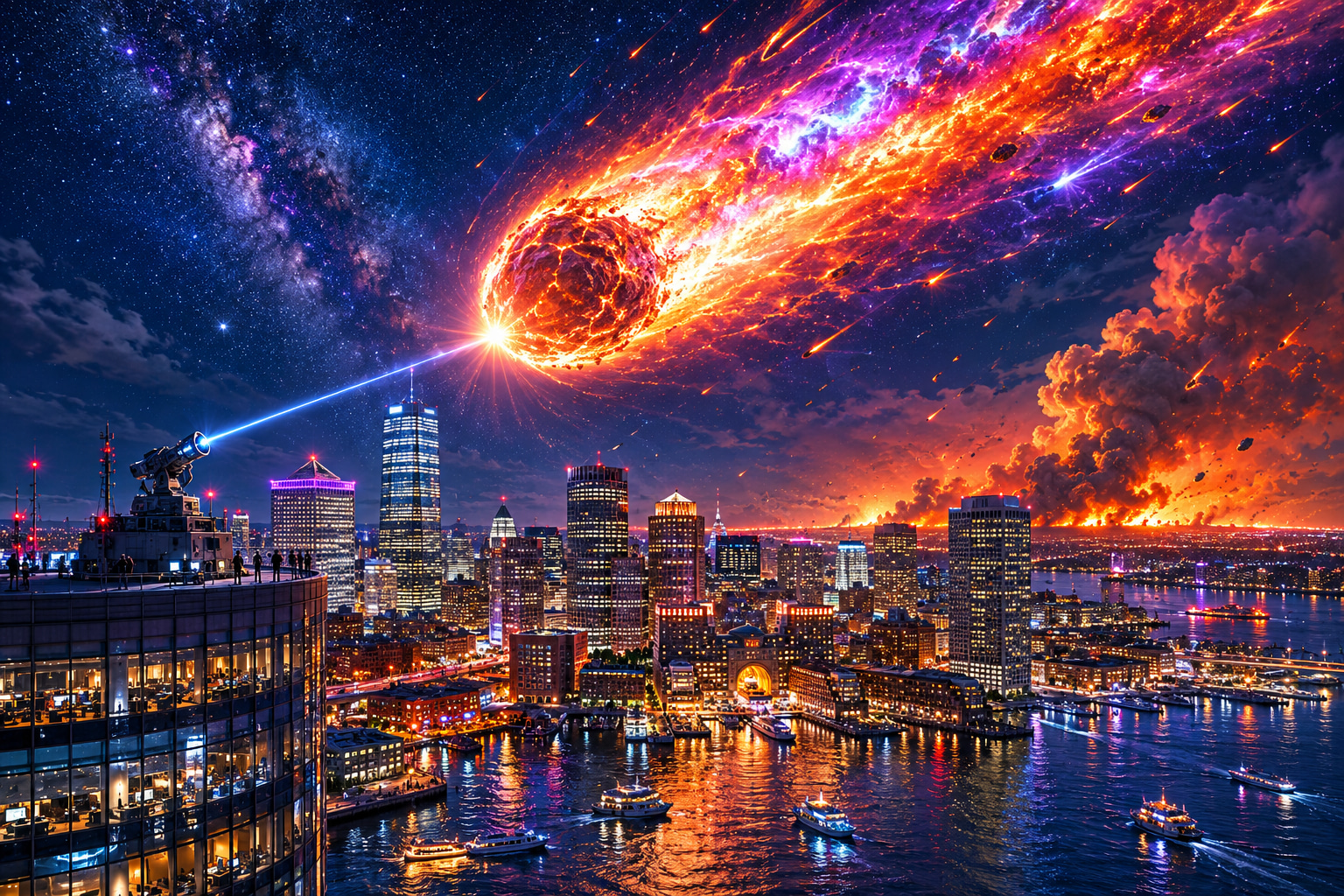
BOSTON, Mass. — A bright meteor streaked across the skies of Massachusetts this week, producing a flash visible across multiple communities and reminding observers of a reality that modern civilization rarely confronts directly: Earth remains exposed to a natural threat that no government, military alliance or technology company can fully control.
The object was relatively small. It burned through the atmosphere and caused no known damage. Yet events like this matter for reasons that go far beyond the individual rock itself.
Every meteor entering Earth's atmosphere is evidence of a larger environment that operates beyond political borders and beyond human authority. Thousands of near-Earth objects cross the planet's orbital neighborhood every year. Most are harmless. Some are not.
The challenge is not that scientists are unaware of the danger. NASA's Planetary Defense Coordination Office, international observatories and asteroid-tracking networks monitor thousands of objects capable of approaching Earth. The problem is scale. Space is vast, detection remains incomplete, and smaller bodies can still arrive with little warning.
A System Built for Prediction, Not Prevention
Modern planetary defense is strongest when threats are identified years in advance.Large asteroids with stable trajectories can often be tracked, modeled and monitored. NASA's DART mission demonstrated that humanity can alter the path of an asteroid under controlled conditions. But that success does not eliminate the broader vulnerability.
Many smaller objects remain difficult to detect because of their size, speed, approach angle or position relative to the Sun. Some may only become visible shortly before atmospheric entry.
That means the gap between discovery and impact can vary dramatically depending on the object involved.
The Massachusetts meteor was harmless. The orbital environment that produced it is not.
Civilization Lives Under an Open Sky
The modern world depends on infrastructure that was never designed with cosmic hazards in mind.Power grids, telecommunications systems, satellite networks, transportation hubs and densely populated urban corridors all operate beneath the same atmosphere through which natural objects continue to arrive.
Most days, nothing happens.
Occasionally, a fireball appears over a city and briefly forces a different perspective. The event becomes a reminder that planetary defense is not a science-fiction concept or a distant academic exercise. It is an acknowledgement that human civilization exists inside a larger celestial system that remains only partially mapped and only partially understood.
The meteor over Massachusetts did not create a crisis.
What it revealed was something quieter: even in an age of artificial intelligence, nuclear deterrence and global surveillance networks, the planet still relies on a fragile combination of observation, probability and luck whenever something arrives from space.
And eventually, one object will be larger than the last.
----
Sources:
NASA Planetary Defense Coordination Office
NASA DART Mission
NASA CNEOS